How to host a poker night at home for the first time
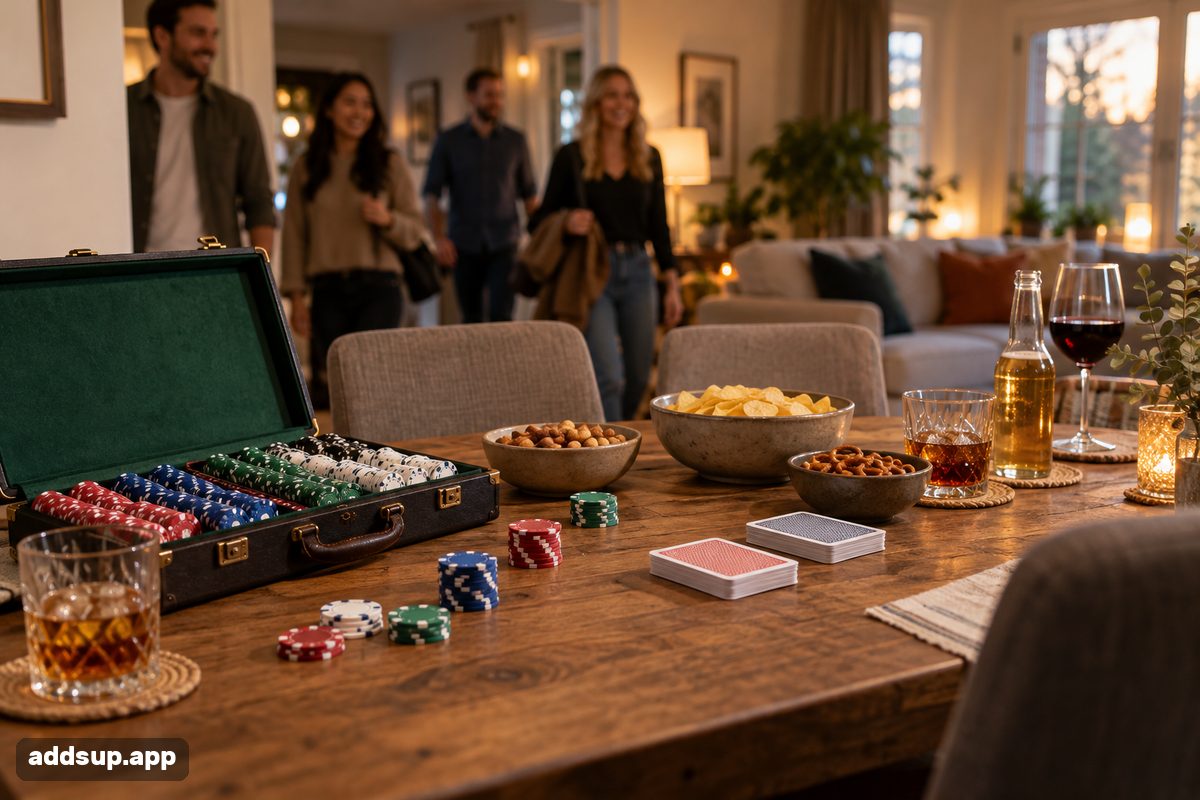
A good home poker night starts with four decisions made before the first hand: the buy-in, how many re-entries are allowed and when that window closes, when the night ends, and how the count is settled. The gear is cheap, and the end-of-night argument disappears if every buy-in is logged the moment it happens.
You have invited friends over for your first poker night at home, and suddenly the questions pile up: how many chips do you need, what happens when someone wants to re-enter, and how do you split the money at the end without it turning into an argument. The good news: a home game of Texas hold 'em is one of the easiest evenings to organize, as long as a few decisions are made before the first hand is dealt.
How many players, and who
The comfortable number for a single home table is six or seven. Five still works, eight is getting crowded, and nine needs an unusually long table. More important than the number is the mix: a first night goes better when most players are at a similar level. One experienced player at a table of beginners has no fun, and the beginners can feel it.
Invite a week ahead and ask for a clear answer. A poker night with four people who committed beats a table of eight where half are a "maybe".
What gear you actually need
A 300-chip set in three or four colors covers eight players, and it is also the cheapest set there is. Two decks of cards, so one can be shuffled while the other is in play. A dealer button, which any small object can stand in for. And a table everyone fits around comfortably, with room for glasses. A green felt mat looks the part, but an ordinary dining table with a tablecloth works exactly the same.
On snacks: things you can eat with one hand that leave no grease on the cards. Nuts, pretzels, cut fruit. Pizza is the enemy of the deck.
Four decisions before the first hand
The buy-in. The amount the most cautious player at the table can lose without thinking about it in the morning. Set it by them, not by whoever talks with the most confidence. We covered this at length in the guide to setting the buy-in.
Re-entries and a cap. How many times someone may re-enter on the same night, and when that window closes. Usually two or three re-entries, with the window closing an hour before the end. Without this, the real stakes of the night get decided at one in the morning.
End time. Set it in advance and respect it. A poker night that ends when everyone is tired produces the worst hands and the most pointless arguments.
Chip values and how you settle. Every color gets a value, announced out loud once. And agree in advance how the count is closed: everyone counts their stack at the end, and whoever is down pays whoever is up.
How to distribute the chips
Many of the low value, fewer of the high. For a 100-unit buy-in, a comfortable split is 20 chips of 1, 10 of 3 and 5 of 10. That leaves enough small chips for the blinds, and nobody has to make change mid-hand. Blinds of 1 and 2 on a 100 buy-in make for a long, relaxed night; 2 and 4 speed things up.
The one thing that actually derails a first night
Not the cards and not the gear, but the count. At one in the morning nobody remembers whether Danny bought in twice or three times, and the clearest agreement from the start of the night falls apart. The fix is logging in the moment: every buy-in is written down as it happens, and at the end of the night there is a number instead of an argument.
That is exactly what Adds Up is for: the host taps in every buy-in in two taps, the whole table sees the pot in real time, and when the night ends the app says who pays whom, in the fewest transfers. No real money inside the app, just the count. A first poker night that ends without an argument is a poker night that gets a second one.
Questions from the table
How many players do you need for a home poker night?
Five to eight. Below five the game gets repetitive fast; at nine or more the table is crowded and hands drag. Six or seven is the comfortable number for a single home table.
What gear do you need for a first poker night?
A 300-chip set in three or four colors, two decks of cards (one shuffles while the other is in play), a dealer button, and a table with room for everyone. A felt mat is nice but not required.
What do you decide before you start?
The buy-in, how many re-entries are allowed and when that window closes, the end time, the value of each chip color, and how the count is settled. One minute of agreements saves fifteen minutes of arguing.
How do you distribute chips to each player?
Many low-value chips, fewer high ones. For a 100-unit buy-in: 20 chips of 1, 10 of 3, 5 of 10. That leaves plenty for the blinds and nobody has to make change mid-hand.
How do you settle up at the end of the night?
Everyone counts their stack, you check that total stacks equal total buy-ins, then whoever is down pays whoever is up in the fewest transfers. Adds Up does that math for you.